Azithromycin
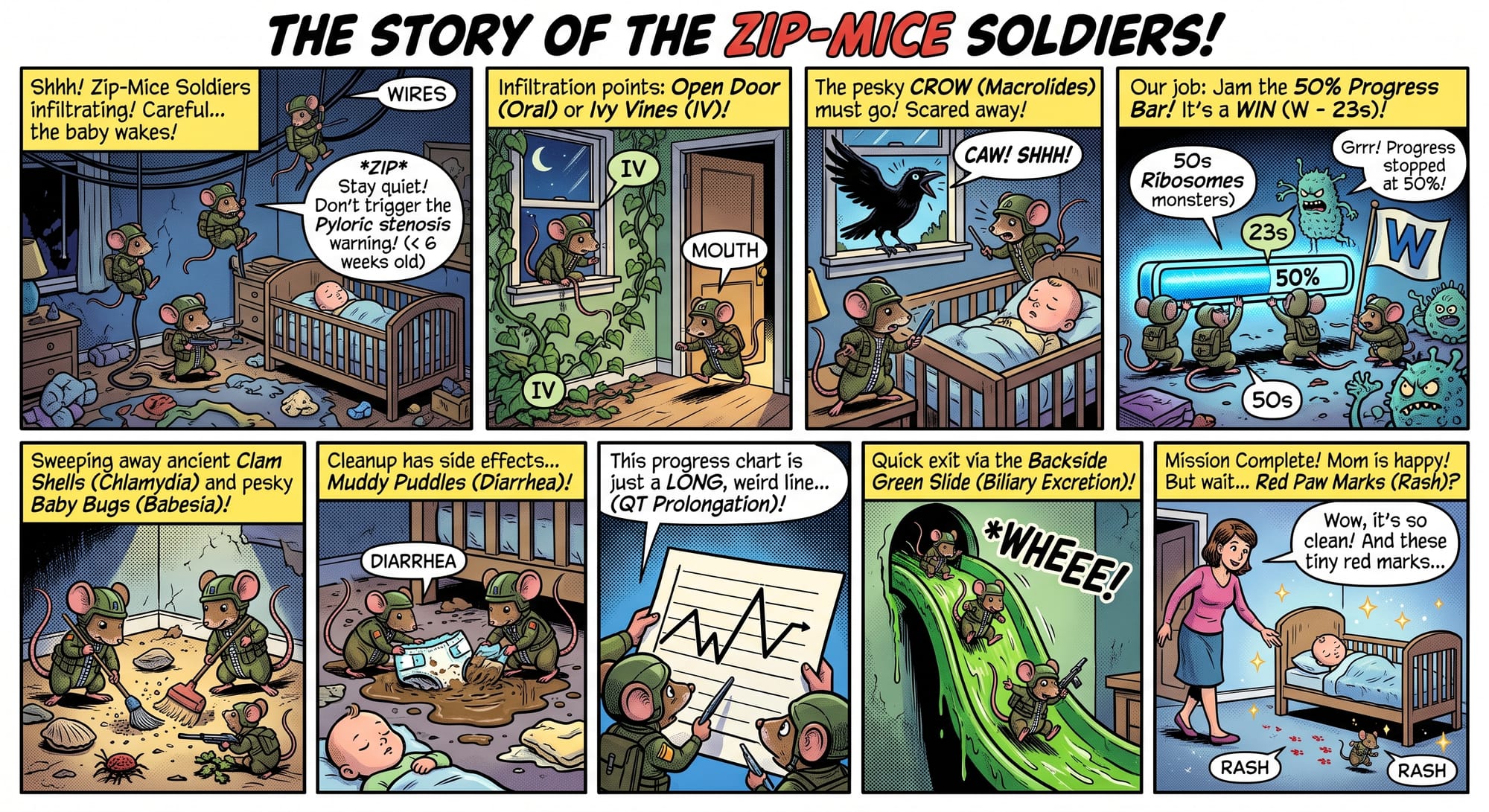
Azithromycin Mnemonic Guide
Panel 1: Drug Identity & Class
A troop of Zip-Mice Soldiers with zippers running right down their bellies sneak into the messy room.
Drug Name: Azithromycin ("Zip-Mice").
The first problem to deal with is the crow sitting on the window constantly cawing and waking the baby, which the mice promptly scare away.
Drug Class: Macrolide antibiotic (Crow symbol).
Panel 2: Administration & Elimination
The mice can enter directly through the wide-open front door or climb in via the poison Ivy vines creeping up the windows.
Route of Administration: Available in Oral / PO (open door) and Intravenous / IV (poison Ivy) formulations.
After finishing their job, the efficient mice make a quick exit down the green slimy slide at the back of the room.
Metabolism & Elimination: Excreted primarily via the biliary system (green slimy slide), requiring no dose adjustment for renal impairment.
Panel 3: Mechanism of Action
The mice encounter a microscopic bacterial legion and jam their progress bar at 50%, claiming a "Win" (W) against their synthesis line.
Mechanism of Action: Inhibits bacterial protein synthesis by binding to the 50S ribosomal subunit, specifically blocking the 23S rRNA (Win / W is the 23rd letter of the alphabet).
Panel 4: Antimicrobial Spectrum & Coverage
The mice suppress the rebellious bacterial legion littering the floor.
Key Coverage: Highly effective against Legionella pneumophila (Legion of rebellion).
Deep cleaning the room's crevices, the mice sweep away dusty, rotten clam shells and eradicate persistent bugs hanging around the baby.
Atypical / Parasitic Coverage: Active against Chlamydia (clam shells) and used in combination therapy for Babesia (baby-hanging bugs).
Panel 5: Adverse Effects & Warnings
The soldiers must avoid dropping wires near the baby, lest the infant play with them, get tangled, and start crying.
Black Box / Age Restriction: Avoid in infants < 6 weeks old due to an increased risk of Infantile Hypertrophic Pyloric Stenosis (IHPS).
Throughout their mission, the mice keep track of progress using an unusually long, single-line chart.
Cardiac Toxicity: Associated with QT interval prolongation, which can trigger Torsades de Pointes.
The mice mop up a muddy diaper puddle on the floor, leaving behind only faint red paw marks as proof of their visit.
Common Side Effects: Gastrointestinal upset/diarrhea (mud puddle) and hypersensitivity rashes (red paw marks).
Member discussion