Bupivacaine
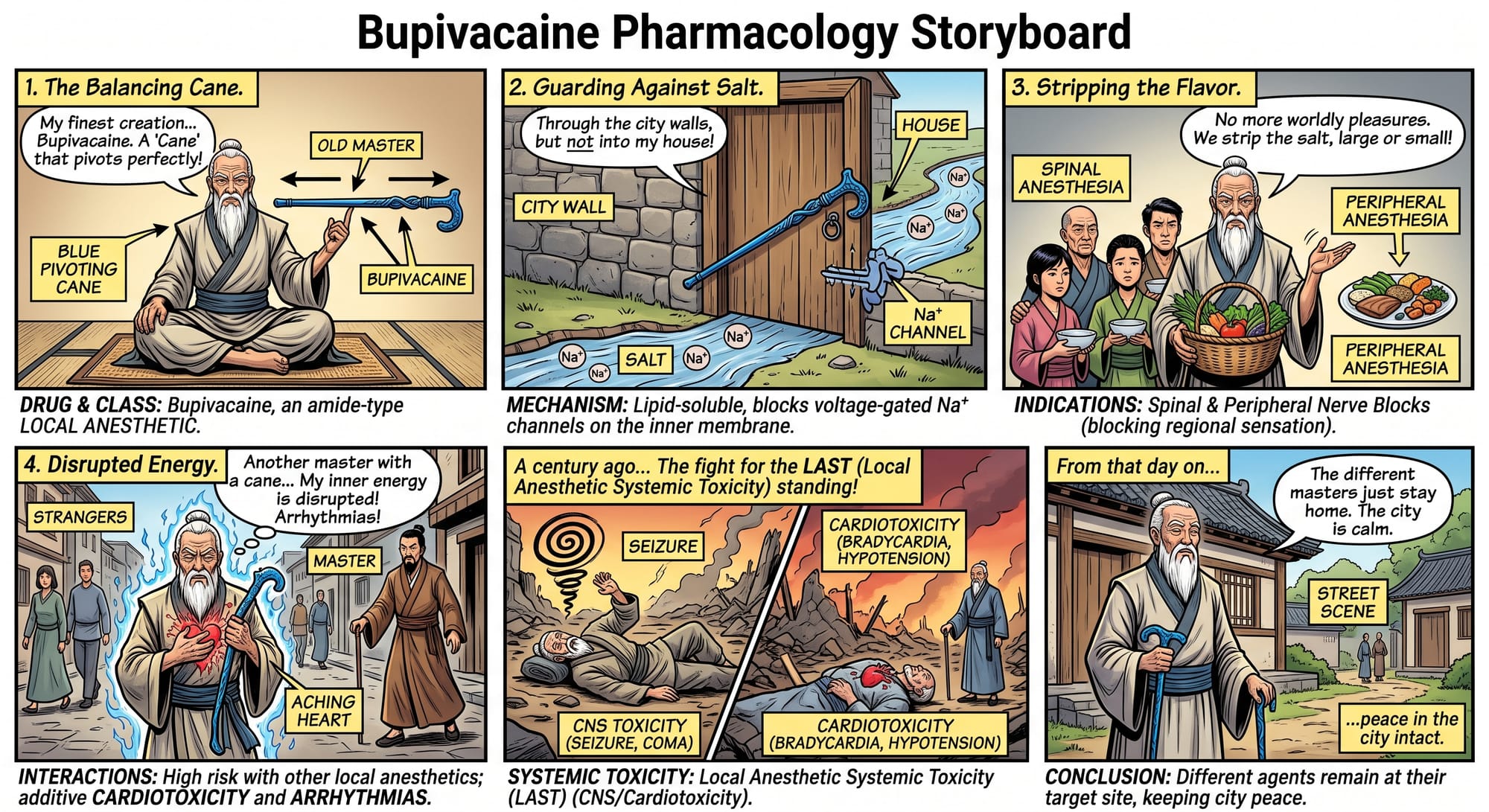
Bupivacaine Pharmacology Storyboard
Panel 1: The Balancing Cane (Drug Identification & Class)
An old master balances a perfectly crafted blue pivoting cane on a single finger.
Drug & Class: Bupivacaine (blue pivoting cane) is an amide-type local anesthetic ("-caine").
Panel 2: Guarding Against Salt (Mechanism of Action & Pharmacokinetics)
The strict old master lets salt pass the outer city wall, but wedges his cane inside the house door to block salt entirely from entering. His long years of training allow him to guard the door for hours.
Mechanism & Properties: As a lipid-soluble agent, it crosses the neuronal membrane to bind and block voltage-gated Na+ channels on the inner membrane, preventing depolarization; it is characterized by a long duration of action.
Panel 3: Stripping the Flavor (Clinical Indications)
To strip away worldly indulgence, the master removes salt sensation either from every dish completely or just from specific selected dishes.
Indications & Routes: Used for spinal anesthesia (blocking sensation to large body regions) and peripheral nerve blocks (targeted regional anesthesia for specific limbs/areas).
Panel 4: Disrupted Energy (Drug Interactions)
The master does not mind regular strangers, but the presence of another master with a cane disrupts his inner energy and makes his heart ache.
Interactions: Features low overall drug-drug interactions, but co-administration with other local anesthetics or antiarrhythmics heightens the risk of additive cardiac toxicity and arrhythmias.
Panel 5: The LAST Standing Master (Toxicity & Adverse Effects)
A century ago, a battle for the LAST master standing left one master's mind seizing and falling into a coma, while another master's heart slowed to a crawl and crashed.
Systemic Toxicity: Overdose causes LAST (Local Anesthetic Systemic Toxicity), presenting with severe CNS toxicity (seizures, coma) and profound cardiotoxicity (bradycardia, severe hypotension, cardiac arrest).
Member discussion