Citalopram
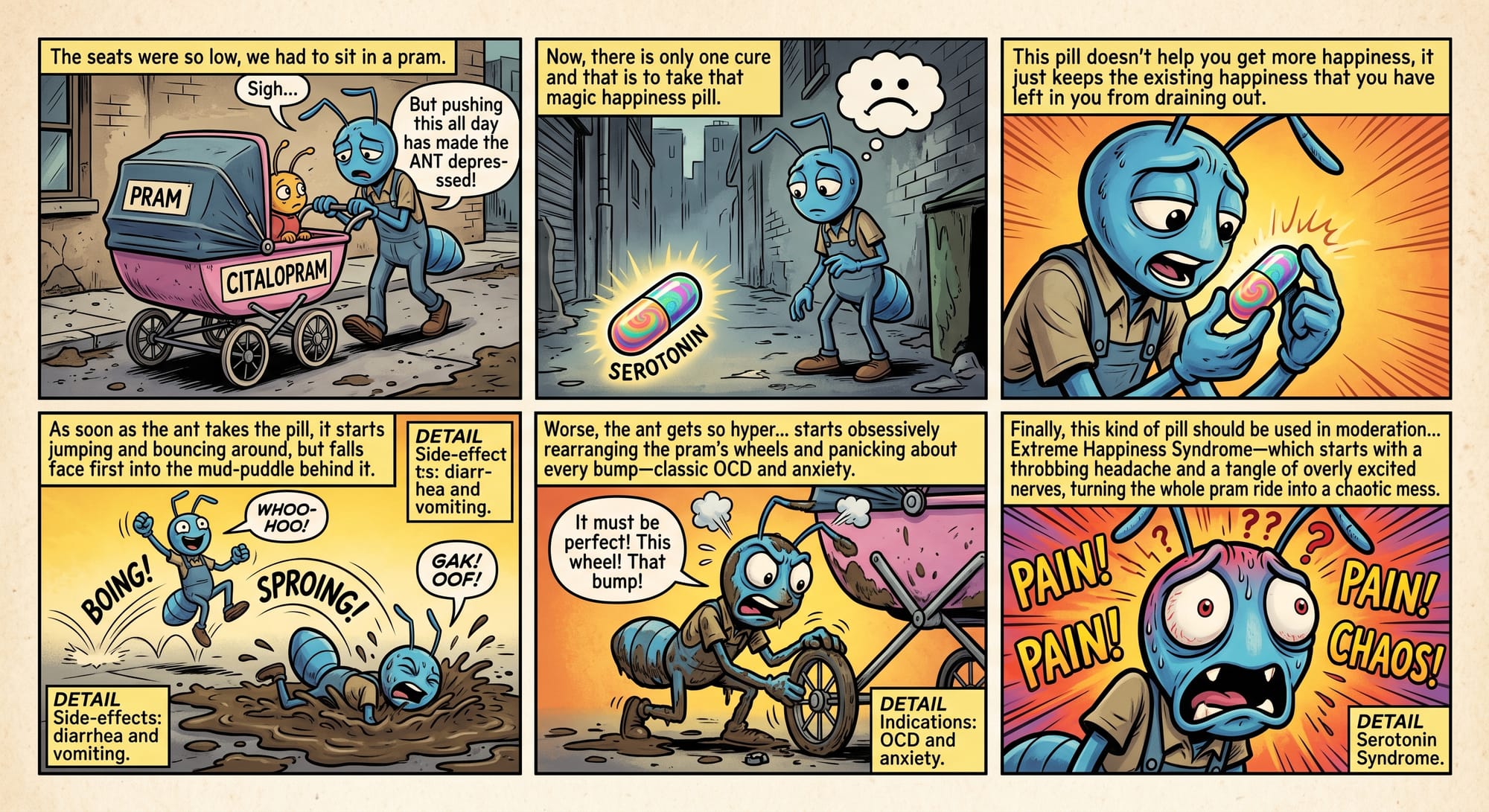
Citalopram: The Tale of the Depressed Pram-Pushing Ant
Panel 1: The Low-Seated Pram (Drug Identity & Class)
The seats were so low that we had to sit inside a low-riding pram. Pushing this pram day in and day out was a tired, blue ANT whose menial chores left it completely depressed.
Drug & Class: Citalopram (represented by the pram), which belongs to the class of antidepressants (represented by the depressed ant).
Panel 2: Trapping the Happiness Spark (Mechanism of Action)
The only cure was a magic happiness pill. It didn't manufacture new cheer; instead, it blocked the exit hatch so whatever lingering happiness the ant still had couldn't drain away.
Mechanism of Action: Acts as an SSRI (Selective Serotonin Reuptake Inhibitor), preventing the reuptake of serotonin (5-HT) into the presynaptic neuron, thereby keeping extracellular concentrations elevated.
Panel 3: The Mud Puddle Wipeout (Common Side Effects)
The ant swallowed the pill and immediately began jumping and bouncing wild somersaults—until it lost its balance and fell face-first into a filthy mud-puddle behind it.
Adverse Effects: Gastrointestinal disturbances are common initial side effects, presenting notably as diarrhea (the mud-puddle) and vomiting / nausea.
Panel 4: Obsessive Wheel Alignment (Clinical Indications)
Jumping back up, the ant became overly hyper, obsessively realigning the pram's wheel bolts in perfect patterns and panicking at every tiny pebble in the road.
Indications: Indicated for Major Depressive Disorder (MDD), Obsessive-Compulsive Disorder (OCD), and various Anxiety Disorders (including Generalized Anxiety and Panic Disorder).
Panel 5: The Overcharge Storm (Serotonin Syndrome)
Too many pills trigger Extreme Happiness Syndrome: a pounding headache, twitching tangled nerves, and an overstimulated, frantic state that turns the entire ride into dangerous bedlam.
Toxicity / Overdose: Excessive doses or combinations can provoke life-threatening Serotonin Syndrome, characterized by headache, hyperreflexia/neuromuscular excitability, autonomic instability, and altered mental status.
Member discussion