Clindamycin
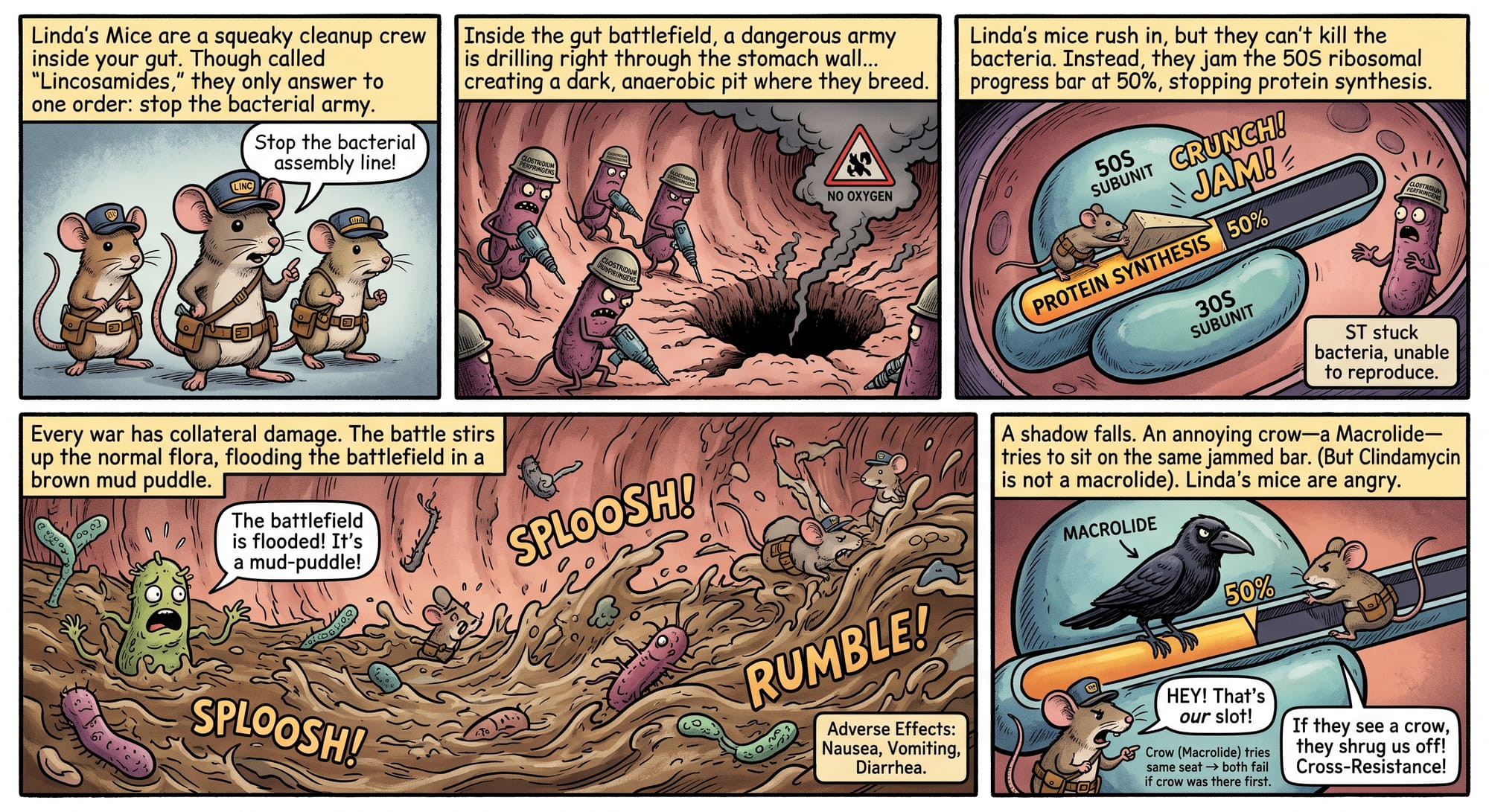
Lincosamides & Clindamycin: Linda's Mice Cleanup Crew
Panel 1: The Squeaky Crew (Drug Class & Identity)
Meet Linda’s Mice, a tiny, squeaky cleanup crew deployed inside the gut. Though officially titled Lincosamides, these determined mice take orders to halt the hostile bacterial army's assembly line.
Drug Class: Represents Lincosamides, primarily Clindamycin ("Linda's Mice"), an antibiotic class distinct from macrolides.
Panel 2: The Anaerobic Trench (Microbial Target & Indication)
Down in the gut battlefield, a dangerous army is drilling a deep perforation through the stomach lining, creating a dark, oxygen-starved anaerobic pit where they rapidly multiply.
Spectrum & Activity: Potent activity against anaerobic bacteria and gas gangrene pathogens, notably Clostridium perfringens, often implicated in deep abdominal trauma and visceral perforations.
Panel 3: The Frozen 50% Progress Bar (Mechanism of Action)
Linda’s mice rush into the pit. Unable to disintegrate the invaders outright, they wedge themselves into the machinery, jamming the progress bar dead at 50% so no new peptide chains can grow. The bacteria are left frozen and half-built.
Mechanism of Action: Acts as a bacteriostatic agent by reversibly binding the 50S ribosomal subunit, inhibiting translocation and halting bacterial protein synthesis.
Panel 4: The Brown Sludge Wave (Adverse Effects)
The destructive skirmish ravages the local peace. Normal gut flora is completely scrambled, quickly submerging the battlefield in a murky brown mud-puddle of churning fluids.
Adverse Effects: Disrupts indigenous intestinal microbiota, commonly triggering gastrointestinal symptoms like nausea, vomiting, and severe diarrhea (with high propensity to provoke Clostridioides difficile colitis).
Panel 5: The Perched Crow (Binding Competition & Cross-Resistance)
A shadow falls as an annoying crow—a Macrolide—swoops down to roost on the identical 50% slot. Because both fight for the exact same perch, if the crow arrived first, Linda's mice bounce right off in frustration.
Cross-Resistance & Interaction: Shares an overlapping ribosomal binding locus with macrolides (e.g., erythromycin); ribosomal methylation causing resistance to macrolides confers cross-resistance to lincosamides (MLSb phenotype).
Member discussion